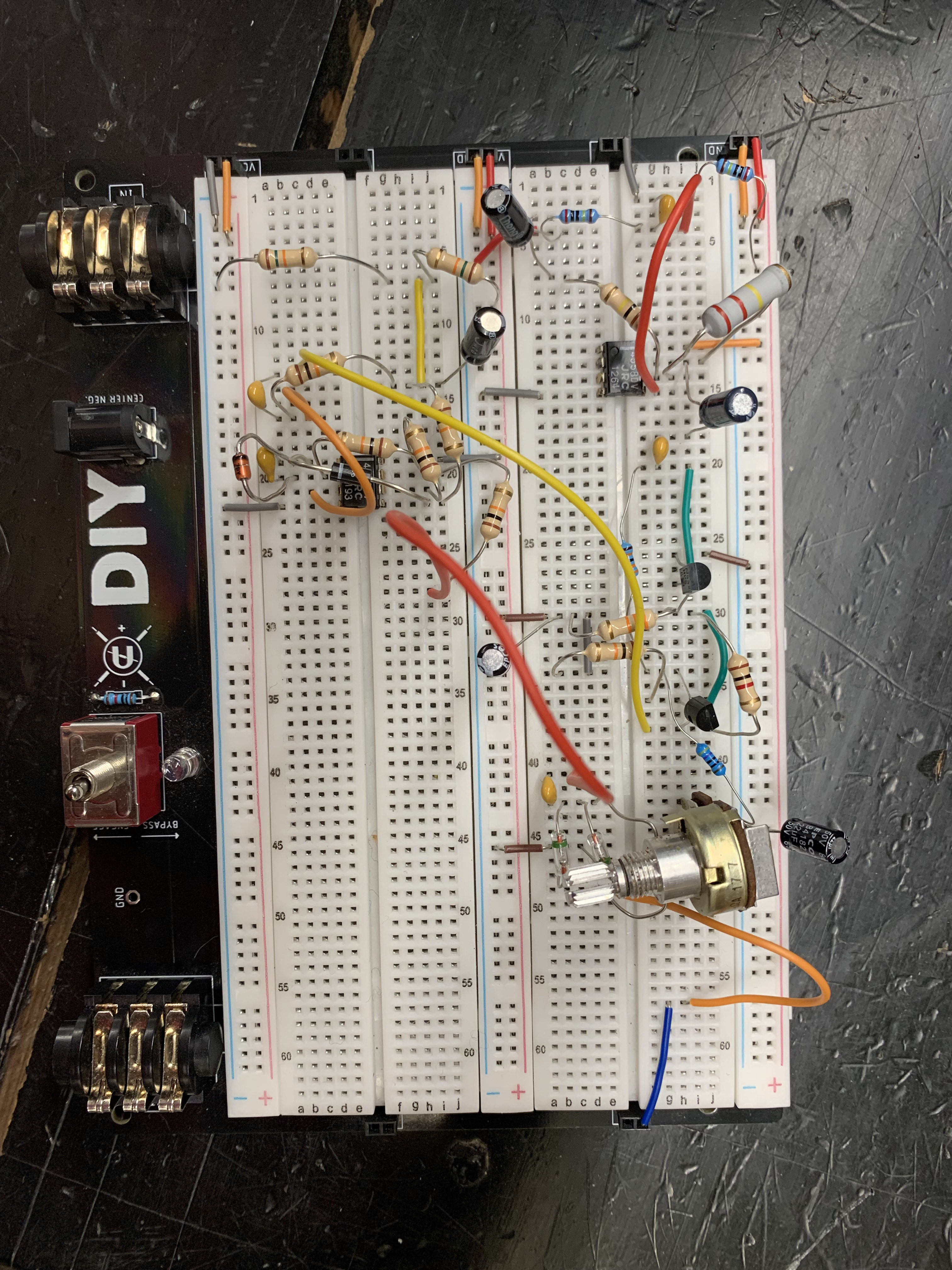
Fuzz Octave Pedal Design Log 1
26 Oct 2025
(A link to the finished schematic and explaination will go here. For now, though, there is this explanation)
At the Baltimore Pedal Expo I had the opportunity to try out many pedals, and one that stuck with me was the Caroline Guitar Company's Wave Cannon Zero. This beautiful distortion allows you to momentarily add "havoc" into the signal, which sounds out of this world cool. It seemed to me at the time to be some sort of octaver circuit (This was wrong, lol. Keep that in mind for later). My wallet was already getting thin from the reverb and delay I "needed" as replacements for some subpar pedals I had. I couldn't justify another distortion at that price, then. And now, really.
So I decided to try and build my own version- it has been a goal of mine to design my own pedals since I started building them in 2020 and now I actually had an idea. This expo was also where I heard about Tim Escobedo's Circuit Snippets- a great resource for any wannabe pedal builder.
(The link for this and other great resources- updated as I find them is here)
This has been what I've been doing for the past 3-4 months on and off and I've finally decided to start blogging about it. Or more like finally got around to blogging about it- as now I've learned some lessons. I want to put this up here because I think that designing pedals was so intimidating for me to start, it seemed to me like music or art- driven by divine inspiration and an intimate knowledge of each electron's motivation and drive. In reality, it's just messing around and trying to break circuits that already exist. It, like art, is a lot of "theft" and a lot of fun.
My initial thought was that I would build a simple fuzz pedal and then add an octaver (another type of softer fuzz) on through a momentary foot pedal. At first I tried the Tripple Fuzz (T. Escobedo) with the plan to tweak it until I like it and then add an octaver and then tweak that. This circuit though, didn't have the power that I was hoping for, though. When the fuzz was turn all the down (or resistance on the pot was turn all the way up) the sound would cut out. Volume also had to be turned all the way up (resistance turned all the way up) for a decent sound to come out. This was no good- if you can't use every setting on the pot that's not a good design. So I putzed around looking at other circuits trying to figure out what to do and then I came up with this block diagram.
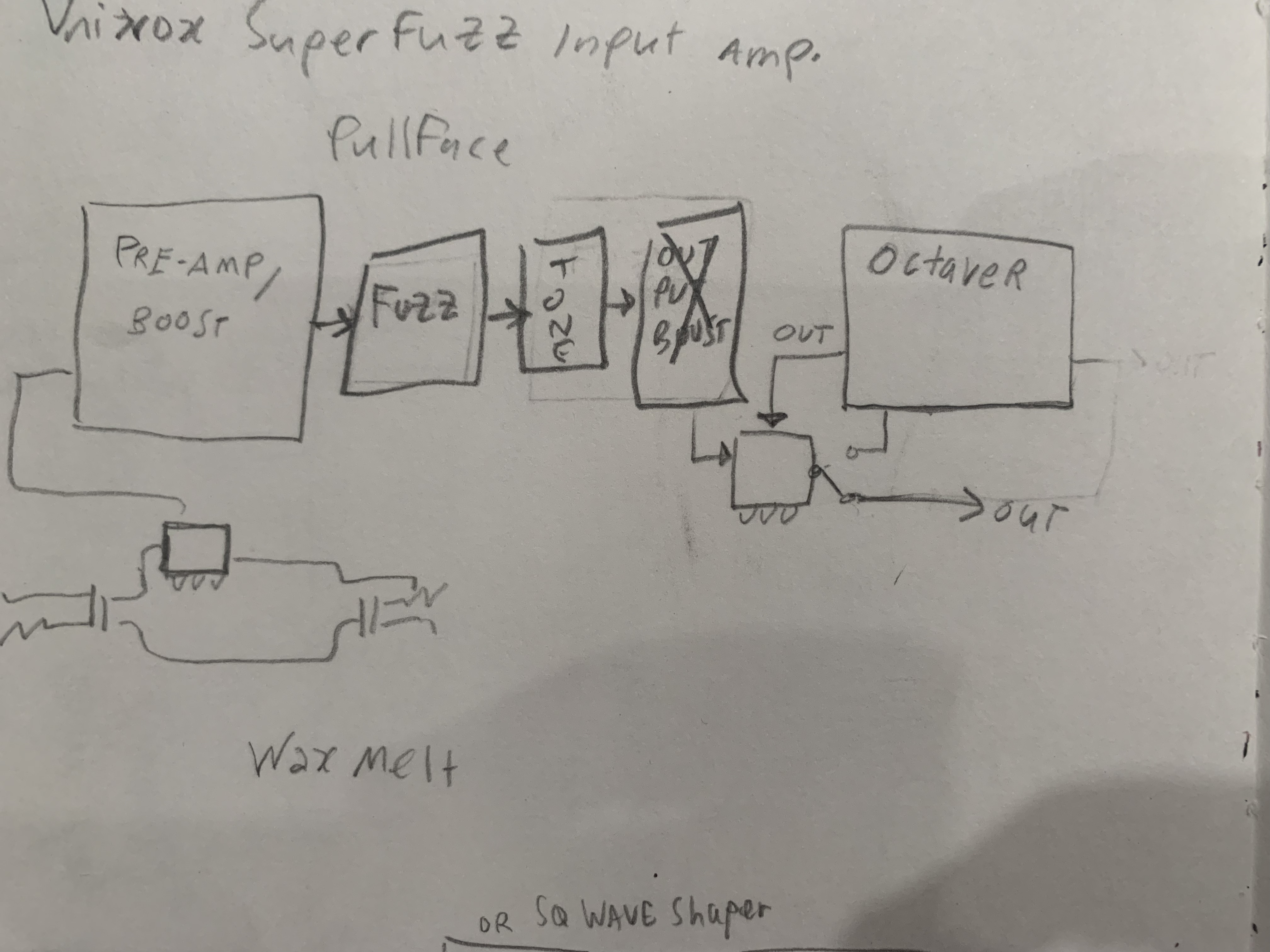
I need a clean boost! At the front to guarantee some heavy fuzz tones at all times. My goal was for the Fuzz to sound like crazy distortion to a thick buzzy fuzz tone. And for that I needed to blow that signal up! So I found this circuit for a clean op-amp boost. I used a 4558D that I stole off of an old Yamaha (This may be a blog for another time). This one I didn't adjust much, because I'm not sure it will matter much to the rest of the sound.
So this boost would go into a fuzz, but I wanted to use a different fuzz circuit as the base. The Tripple Fuzz (T. Escobedo) triples the signal- similar to an octaver effect. But I want the octaver tone to really stand out, so that won't do. I decide to start with Punch in the Face (T. Escobedo), a simple two transister fuzz. I drop the jfet for another MSA18 and I drop the "trauma" control completely. (Explain what Trauma is). Now I have a pretty solid fuzz, but the tone sucks. I start messing with the circuit pulling from other fuzz circuits. Obviously I add clipping diodes- this really is a must for me. Currently I'm using some small PIN/zener diodes (another courtesy of the Yamaha). My ideas are below.
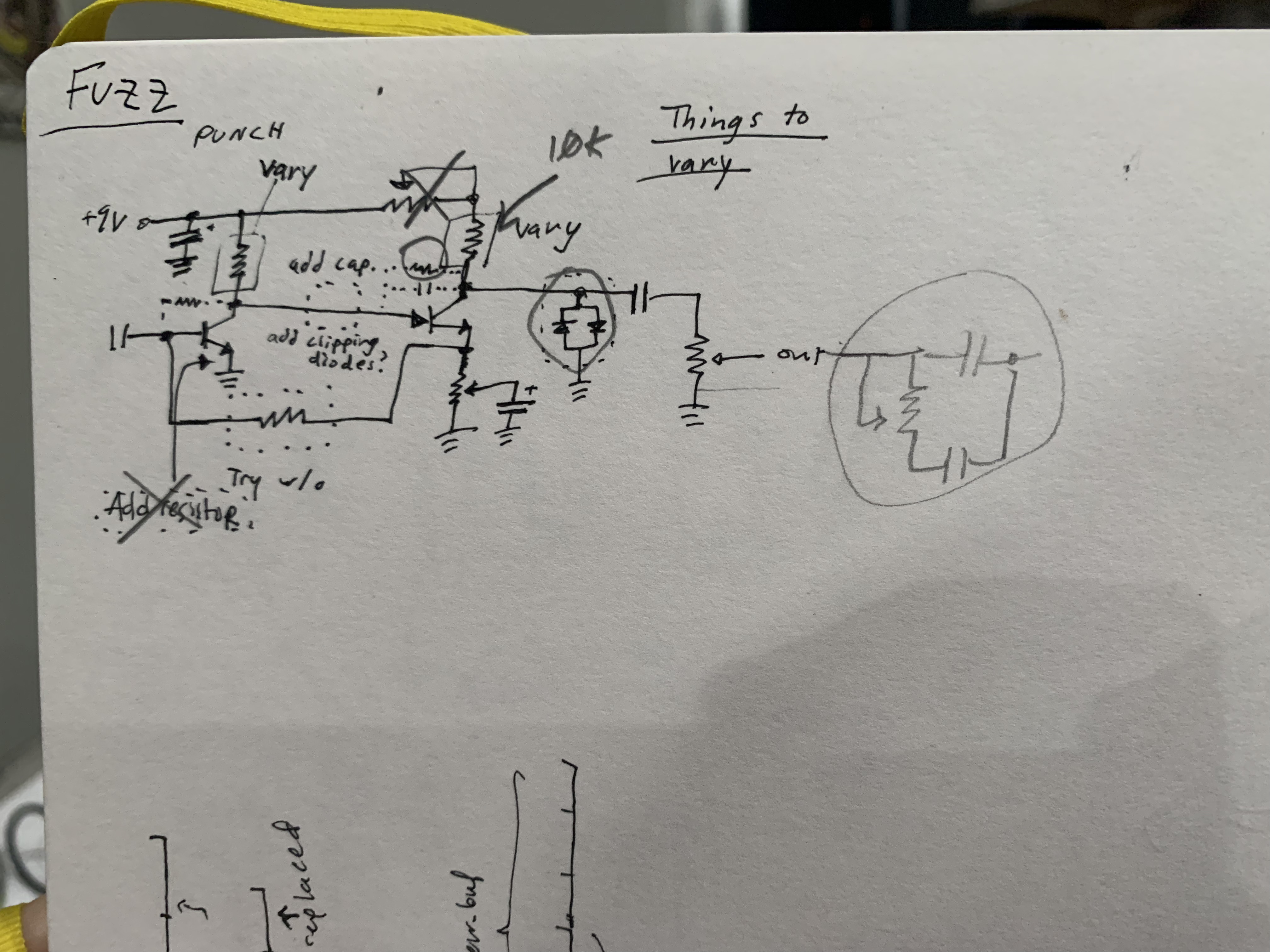
I really like the parallel resistor for the second transistor, the capacitor doesn't add to the effect though, so I keep it out. The clipping diodes in between the transistors do nothing (worth a shot though!). And I don't add the band pass filter (Tone) yet.
It sounds good, at every level, so I move on. This time I have two octavers I've found: Octave Up from Tim and Super Full Wave Octaver. I start with the Octave Up- inserting it before the clipping diodes and volume resistor of the first circuit. I end up getting rid of the Darlington at the beginning of the circuit because I already have plenty of gain (Although, as noted later, maybe not enough. I may have to add a transistor with less gain at the start). So it ends up looking like this:

This sounds okay, I certainly like it. I also mess around with the circuit and make some pretty cool sounds. None of them are quite right for this pedal. I take it out and build the Full-Wave octaver. This one also sounds very cool, and a little cleaner- which I like. The signal loses some volume though. And I'm not hearing much of a difference between the fuzz and fuzz with octaver. I add a simple tone filter to the end, but that doesn't do much to make the signal pop. So I decide to finally look at the Wave Cannon Zero circuit. Egad! I was wrong! The "havoc" control adds feedback. When I try that out it sounds...right... But sunk cost fallacy and the desire to innovate keeps me trying to use the Octave. Using feedback or different insertion points for the fuzz isn't working for the Super Full Wave Octaver. Next time I work on it I plan to test out a feedback model with the octave up circuit and see if I can't get something to work out there.